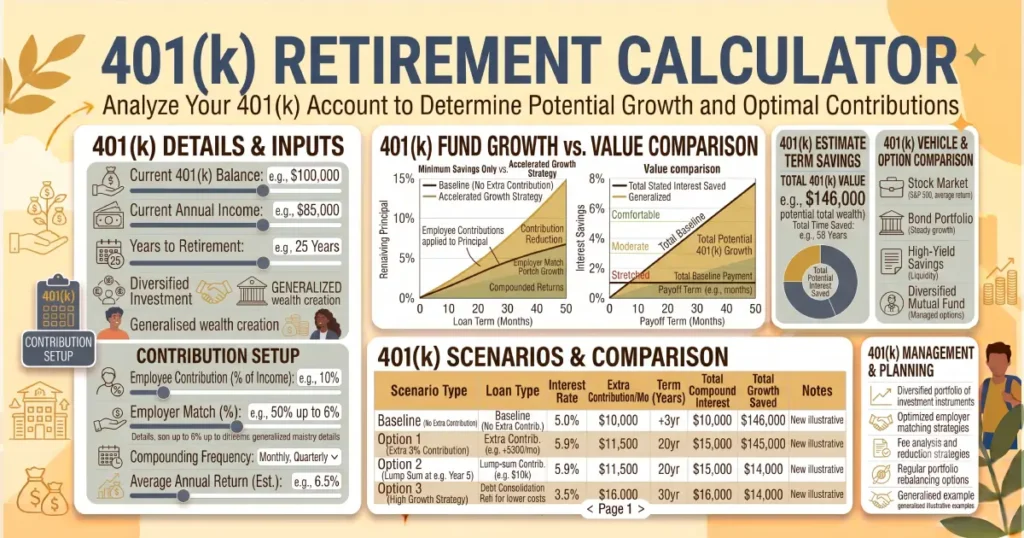
A 401(k) retirement calculator helps estimate how much your workplace retirement account may grow over time and how much income it could provide during retirement. By entering your current 401(k) balance, salary, contribution rate, employer match, expected investment return, and retirement timeline, you can create a projection of your potential future savings.
How a 401(k) Retirement Calculator Works
A 401(k) calculator estimates future account value by combining your current savings with ongoing contributions and potential investment growth. The calculation considers how much you contribute from each paycheck, whether your employer provides a match, and how long your money remains invested.
Most calculations include:
- Current 401(k) balance
- Annual salary
- Employee contribution percentage
- Employer matching contribution
- Expected annual return
- Years until retirement
- Contribution limits
The result is an estimate of your potential retirement balance. Actual results will vary because investment returns are not guaranteed and market conditions change over time.
What Information Do You Need?
| Input | Description |
|---|---|
| Current 401(k) balance | The amount already saved in your retirement account. |
| Annual salary | Used to calculate contribution amounts and employer matching. |
| Employee contribution | The percentage or dollar amount you contribute from your paycheck. |
| Employer match | Additional contributions made by your employer based on plan rules. |
| Investment return | The estimated annual growth rate of your investments. |
| Retirement age | Determines how long your account has to grow. |
How 401(k) Contributions Grow Over Time
A 401(k) can grow through two main sources: your contributions and investment returns. Employer matching contributions can also significantly increase your retirement savings because they add money to your account without requiring additional savings from you.
For example, an employee contributing 6% of their salary with a company that matches part of those contributions may accumulate savings faster than an employee investing only their own money.
The earlier you begin contributing, the more time compound growth has to work.
Understanding Employer 401(k) Matching
Many employers offer matching contributions as part of their retirement benefits. The employer may contribute additional money based on how much you save, up to a specific percentage of your salary.
Common matching structures include:
- Matching 50% of employee contributions up to a certain percentage.
- Matching dollar-for-dollar up to a specific limit.
- Providing automatic employer contributions regardless of employee contributions.
The exact rules depend on your employer's retirement plan documents.
Traditional 401(k) vs Roth 401(k)
| Feature | Traditional 401(k) | Roth 401(k) |
|---|---|---|
| Contributions | Usually made before taxes | Made after taxes |
| Tax benefit | May reduce taxable income today | Potential tax-free qualified withdrawals |
| Retirement withdrawals | Generally taxed as income | Generally tax-free if requirements are met |
The better option depends on your current tax situation, expected future income, and retirement goals.
Factors That Affect Your 401(k) Growth
Contribution Rate
The percentage of your income you contribute has a major impact on your future retirement balance. Increasing contributions over time can significantly improve long-term results.
Employer Match
Employer contributions can accelerate retirement savings because they increase your account balance without requiring additional employee contributions.
Investment Performance
Your chosen investments influence how quickly your account grows. Higher potential returns generally involve higher levels of risk.
Time Until Retirement
The number of years your money remains invested affects the potential impact of compound growth.
Fees
Investment and plan fees reduce your overall returns. Even small fees can have a meaningful impact over several decades.
Why Use a 401(k) Calculator?
- Estimate your future retirement savings.
- See how increasing contributions affects growth.
- Understand the value of employer matching.
- Compare different retirement scenarios.
- Determine whether you are saving enough.
- Create a more realistic retirement plan.
Common 401(k) Planning Mistakes
- Not contributing enough to receive the full employer match.
- Starting retirement savings too late.
- Ignoring investment fees.
- Assuming market returns are guaranteed.
- Never increasing contributions after receiving raises.
- Not reviewing investment choices periodically.
How Much Should You Contribute to a 401(k)?
The right contribution amount depends on your income, expenses, retirement goals, and financial situation. Many financial professionals recommend contributing enough to receive any available employer match because it represents additional compensation.
A 401(k) calculator allows you to test different contribution levels and see how increasing your savings rate may affect your projected retirement balance.
401(k) Withdrawal Considerations
Your 401(k) is designed for retirement savings, and withdrawing money before retirement age may result in taxes or penalties depending on your circumstances.
Before taking withdrawals, consider:
- Your retirement timeline
- Potential tax consequences
- Alternative sources of funds
- Your long-term financial goals
Frequently Asked Questions
A 401(k) retirement calculator estimates how your workplace retirement account may grow based on your current balance, contributions, employer match, investment returns, and years until retirement.
A 401(k) calculator provides an estimate based on assumptions about contributions and investment returns. Actual results may differ because markets fluctuate and future investment performance is uncertain.
The ideal contribution depends on your income, expenses, retirement goals, and employer benefits. Many employees start by contributing enough to receive the full employer match and increase savings over time.
Yes, many calculators allow you to include employer matching contributions. Adding this information creates a more realistic estimate of your potential retirement savings.
Compound growth allows your investment earnings to generate additional earnings over time. Starting earlier gives your contributions more time to potentially grow.
The better choice depends on your tax situation and retirement plans. Traditional 401(k) contributions may provide tax benefits today, while Roth 401(k) contributions may provide tax-free qualified withdrawals later.
A calculator can estimate whether your projected savings may support retirement goals, but retirement decisions also depend on expenses, healthcare costs, Social Security, and personal circumstances.
Stopping contributions means you lose future savings opportunities and may miss employer matching contributions. However, your existing investments can continue growing or declining based on market performance.