A salary to hourly calculator converts an annual salary into an estimated hourly wage, helping employees and job seekers understand the true value of their compensation. Comparing salary offers, evaluating career opportunities, and planning personal finances becomes easier when you know how much your yearly income equals per hour.
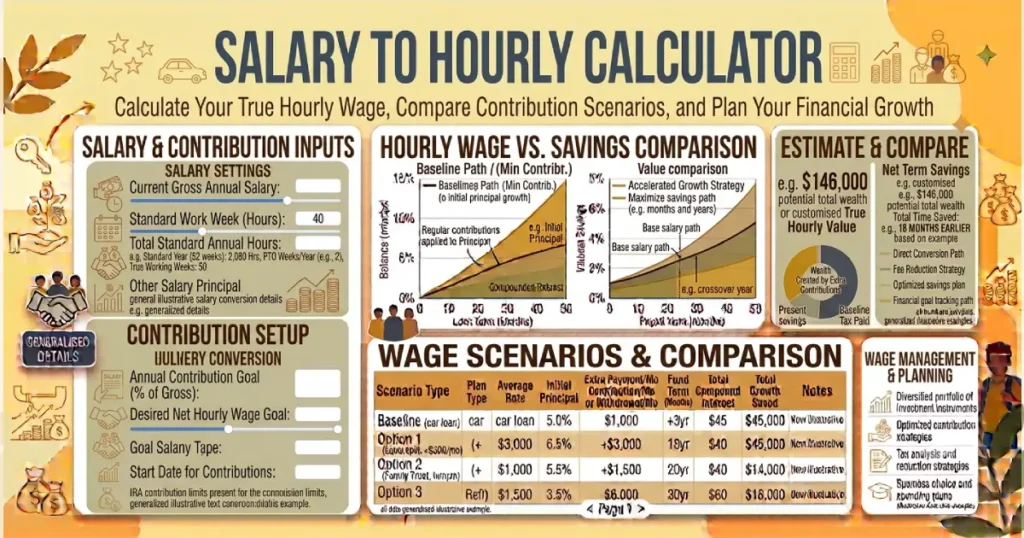
How a Salary to Hourly Calculator Works
A salary conversion calculator divides your annual pay by the total number of hours you work in a year. The standard calculation assumes a full-time schedule of 40 hours per week and 52 weeks per year, which equals 2,080 working hours.
The basic formula is:
Annual Salary ÷ Total Hours Worked Per Year = Hourly Rate
For example, a $60,000 annual salary divided by 2,080 working hours equals approximately $28.85 per hour before taxes and deductions.
Your actual hourly equivalent may be different if you work part-time, receive paid time off, work overtime, or have additional compensation such as bonuses.
What Information Do You Need?
| Input | Purpose |
|---|---|
| Annual salary | The total gross income you receive before deductions. |
| Hours worked per week | Determines your yearly working hours. |
| Weeks worked per year | Adjusts calculations for vacation, seasonal work, or unpaid leave. |
| Overtime hours | Helps estimate additional earnings beyond base salary. |
Salary to Hourly Conversion Examples
The following examples assume 40 hours per week and 52 working weeks per year.
| Annual Salary | Hourly Equivalent |
|---|---|
| $40,000 per year | $19.23 per hour |
| $50,000 per year | $24.04 per hour |
| $60,000 per year | $28.85 per hour |
| $75,000 per year | $36.06 per hour |
| $100,000 per year | $48.08 per hour |
Why Convert Salary to Hourly Pay?
Knowing your hourly equivalent can provide a clearer understanding of your compensation. An annual salary may appear attractive, but the number of hours required to earn that amount affects the real value of the job.
Salary-to-hourly conversion can help you:
- Compare salaried and hourly job offers.
- Evaluate whether overtime opportunities are valuable.
- Understand the effect of longer working hours.
- Calculate freelance or consulting rates.
- Negotiate compensation more effectively.
Salary vs Hourly Pay: Important Differences
Salary and hourly compensation are structured differently. A salaried employee generally receives a fixed annual amount, while an hourly employee is paid based on the number of hours worked.
- Hourly employees may qualify for overtime pay depending on their job classification.
- Salaried workers often have predictable income each pay period.
- Benefits may differ between hourly and salaried positions.
- The same annual income can represent different hourly values depending on workload.
Factors That Change Your Real Hourly Rate
Working Hours
If you regularly work more than 40 hours per week, your effective hourly rate decreases because you spend more time earning the same salary amount.
Paid Time Off
Vacation days, holidays, and paid leave can increase the value of a salary because you continue receiving income without working those hours.
Bonuses and Additional Compensation
Annual bonuses, commissions, and employer benefits can increase your total compensation beyond your base salary.
Benefits Package
Health insurance, retirement contributions, and other workplace benefits have financial value and should be considered when comparing job offers.
How to Calculate Your Effective Hourly Rate
Your effective hourly rate considers the actual time spent working, including extra hours beyond your standard schedule.
For example, an employee earning $80,000 per year who works 50 hours per week instead of 40 hours has a lower effective hourly rate because the salary is spread across more working hours.
This calculation can be useful when deciding whether a new position, promotion, or career change is financially worthwhile.
Common Mistakes When Converting Salary to Hourly
- Using 2,080 hours without considering actual work hours.
- Ignoring overtime or additional responsibilities.
- Comparing salary without including benefits.
- Confusing gross income with take-home pay.
- Forgetting unpaid time off.
Frequently Asked Questions
To convert salary to hourly pay, divide your annual salary by the number of hours you work each year. A common calculation uses 2,080 hours based on a 40-hour workweek and 52 weeks per year.
A $50,000 annual salary equals approximately $24.04 per hour when calculated using 2,080 working hours per year. Your actual hourly equivalent may change depending on your schedule, overtime, and unpaid time off.
A $60,000 yearly salary equals about $28.85 per hour based on a standard full-time schedule. This represents gross pay before taxes, insurance deductions, retirement contributions, and other payroll deductions.
No. Most salary conversion calculators show gross income before taxes. Your take-home hourly value depends on federal taxes, state taxes, benefits, retirement contributions, and other deductions.
The standard calculation uses 2,080 hours per year, which comes from working 40 hours per week for 52 weeks. However, your actual yearly hours may be different depending on your schedule.
Yes. Converting salary to an hourly rate can help freelancers estimate comparable pricing. Freelancers should also consider business expenses, taxes, insurance, and unpaid administrative work.
Neither option is always better. Salary may provide predictable income and benefits, while hourly work may offer overtime opportunities. The best choice depends on your schedule, compensation package, and career goals.
Yes. Benefits such as health insurance, retirement contributions, paid vacation, and bonuses can significantly affect the total value of a compensation package.