An investment calculator helps estimate how your money may grow over time based on your initial investment, contributions, expected return rate, and investment period. Whether you are saving for retirement, building wealth, or comparing different investment strategies, an investment calculator can show how compound growth may affect your future balance.
How an Investment Calculator Works
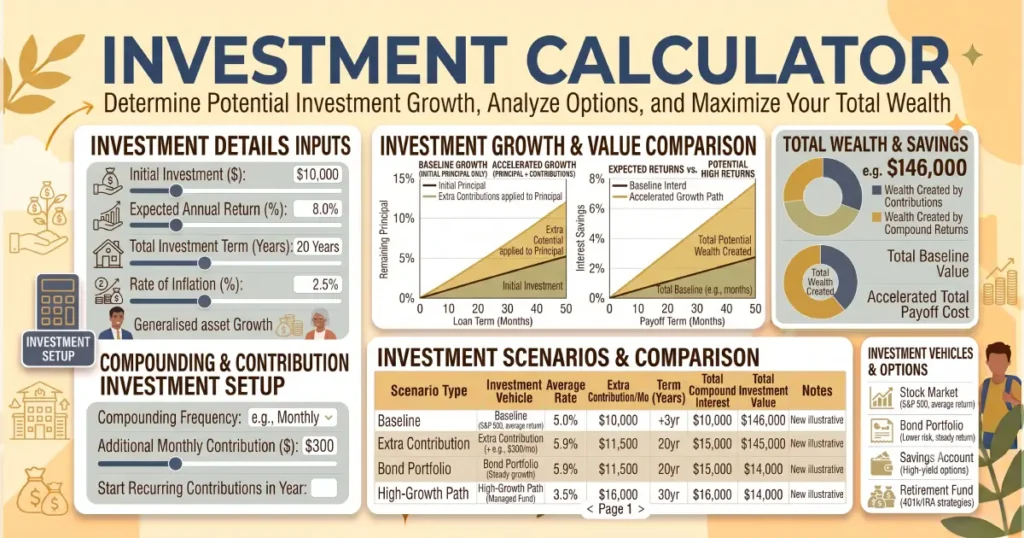
An investment calculator estimates future value by combining your starting amount, additional contributions, expected annual return, and the length of time your money remains invested.
The calculation is based on the principle of compound growth, where investment returns can generate additional earnings over time.
Common inputs include:
- Initial investment amount
- Monthly or annual contributions
- Expected rate of return
- Investment time period
- Compounding frequency
The calculator provides an estimate, not a guaranteed result. Actual investment performance depends on market conditions, fees, taxes, and the investments you choose.
Understanding Compound Growth
Compound growth allows your investment earnings to generate their own earnings. Over long periods, this effect can significantly increase the value of your portfolio.
For example, investing consistently over several decades may produce substantially different results compared with keeping money in a non-growing account because returns are added back into the investment balance.
The main factors affecting compound growth are:
- Time – Longer investment periods allow more opportunity for growth.
- Rate of return – Higher returns can increase future value, but usually involve greater risk.
- Contributions – Adding money regularly increases the amount invested.
- Compounding frequency – More frequent compounding can slightly affect results.
What Information Do You Need?
| Input | Description |
|---|---|
| Initial investment | The amount you invest at the beginning. |
| Regular contributions | Additional money added monthly or annually. |
| Expected return | The estimated annual percentage growth rate. |
| Investment period | The number of years your money remains invested. |
| Compounding frequency | How often investment earnings are added to your balance. |
Example Investment Growth Calculation
Suppose you invest $10,000 initially and add $200 every month for 20 years. If your investment earns an average annual return of 7%, the final balance could be significantly higher than your total contributions because of compound growth.
| Example Input | Value |
|---|---|
| Initial investment | $10,000 |
| Monthly contribution | $200 |
| Investment period | 20 years |
| Expected return | 7% annually |
Actual returns will vary, and past performance does not guarantee future results.
Why Use an Investment Calculator?
- Estimate future portfolio growth.
- Understand the impact of regular investing.
- Compare different savings strategies.
- Set realistic financial goals.
- See how time affects investment results.
- Plan for retirement or major expenses.
Factors That Affect Investment Returns
Investment Time Horizon
The amount of time your money remains invested can have a major impact on growth. Longer periods generally provide more opportunity for compound returns.
Rate of Return
The expected return is one of the most important assumptions in an investment calculation. Higher expected returns usually involve greater uncertainty and risk.
Investment Contributions
Regular contributions can significantly increase your final balance. Consistent investing may help build wealth over time regardless of short-term market movements.
Fees and Expenses
Investment fees reduce your overall returns. Even small annual fees can affect long-term growth because they reduce the amount of money that remains invested.
Taxes
Tax treatment depends on the type of account and investment. Retirement accounts and taxable investment accounts may produce different after-tax results.
Investment Calculator vs Savings Calculator
An investment calculator and a savings calculator both estimate future money growth, but they are designed for different purposes.
| Feature | Investment Calculator | Savings Calculator |
|---|---|---|
| Growth source | Market-based returns | Interest from savings accounts |
| Risk level | Usually higher | Usually lower |
| Potential return | Variable | Generally predictable |
| Common uses | Retirement and wealth building | Short-term savings goals |
Common Investment Mistakes
- Assuming investment returns are guaranteed.
- Ignoring fees and taxes.
- Focusing only on short-term market changes.
- Waiting too long to start investing.
- Not adjusting contributions as income changes.
How to Use Investment Calculations for Financial Planning
An investment calculator can help you estimate whether your current savings strategy aligns with your goals. You can test different scenarios by changing your contribution amount, expected return, or investment timeline.
For example, increasing monthly contributions or extending your investment period may have a significant effect on your projected balance. These estimates can help you make informed decisions, but they should be combined with your personal financial situation and risk tolerance.
Frequently Asked Questions
An investment calculator estimates how much your money may grow over time based on factors such as your starting investment, contributions, expected return, and investment period. It is commonly used for retirement planning, savings goals, and comparing investment strategies.
Compound growth allows investment earnings to generate additional earnings over time. The longer money stays invested, the greater the potential impact of compounding on your overall portfolio value.
No. Investment calculators provide estimates based on assumptions about future returns. Actual results can be higher or lower because markets fluctuate and investment performance is not guaranteed.
The right amount depends on your income, expenses, financial goals, and risk tolerance. An investment calculator can help you understand how different monthly contribution amounts may affect future growth.
The return rate should reflect a reasonable long-term expectation for your chosen investments. Many people use historical averages as a reference, but future returns may differ from past performance.
Yes. Many investors use calculators to estimate whether their current savings and contributions may be enough to support future retirement goals.
Some calculators include fees and taxes, while others provide a basic growth estimate. Including these costs can create a more realistic projection of your potential investment results.
Saving usually focuses on protecting money with lower risk, while investing involves putting money into assets that may increase in value but can fluctuate. Investments typically offer greater growth potential with more risk.