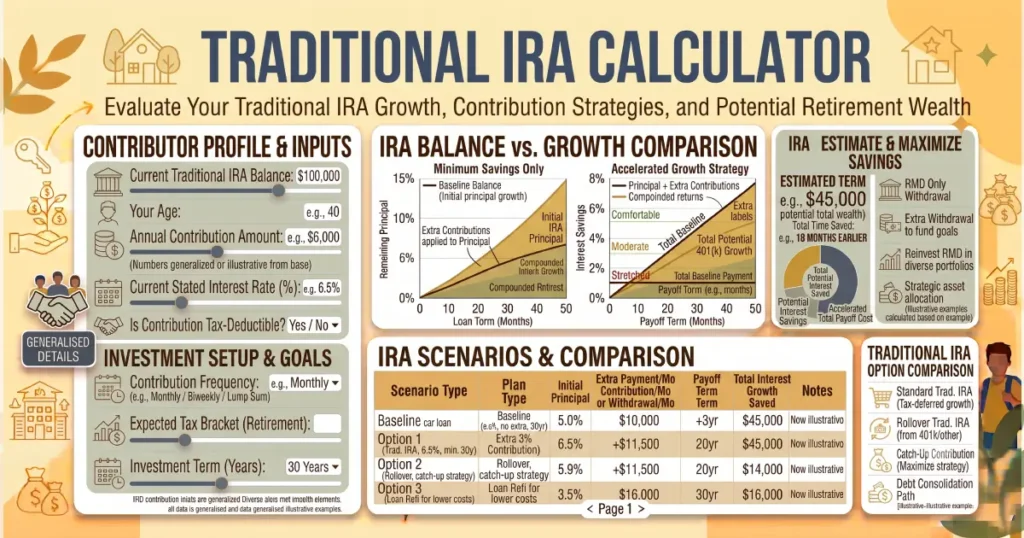
A Traditional IRA calculator helps estimate how your retirement savings may grow over time using tax-deferred contributions and investment returns. By entering your current savings, annual contributions, expected return, and retirement timeline, you can estimate the potential future value of your Traditional IRA and understand how consistent saving may affect your retirement plans.
How a Traditional IRA Calculator Works
A Traditional IRA calculator projects the future value of your retirement account by combining your contributions with estimated investment growth. Traditional IRAs allow eligible investors to save for retirement while potentially receiving tax benefits on contributions, depending on income, filing status, and workplace retirement coverage.
Unlike a taxable investment account, earnings inside a Traditional IRA generally grow tax-deferred. Taxes are typically paid when money is withdrawn during retirement.
A calculator usually considers:
- Current Traditional IRA balance
- Annual contribution amount
- Expected annual investment return
- Current age
- Retirement age
- Contribution frequency
- Expected retirement withdrawal period
The results are estimates based on assumptions. Actual retirement savings may differ because investment returns, inflation, fees, taxes, and personal financial circumstances can change over time.
What Information Do You Need?
| Input | Description |
|---|---|
| Current IRA balance | The amount currently saved in your Traditional IRA. |
| Annual contribution | The amount you plan to contribute each year. |
| Expected return | The estimated yearly growth rate of your investments. |
| Years until retirement | The time your money has to potentially grow. |
| Tax assumptions | Helps estimate the effect of future withdrawals. |
How Traditional IRA Growth Works
A Traditional IRA grows through a combination of contributions and investment returns. The account can typically hold investments such as stocks, bonds, mutual funds, and exchange-traded funds.
The main advantage is tax deferral. Money contributed to a Traditional IRA may qualify for a tax deduction depending on your circumstances, and investment earnings generally are not taxed until withdrawals are made. :contentReference[oaicite:0]{index=0}
Because taxes are usually paid later, a Traditional IRA can be useful for individuals who expect to be in a lower tax bracket during retirement.
Traditional IRA Contribution Rules
Traditional IRA contributions are subject to annual limits and eligibility rules. You generally need taxable compensation to contribute, and the amount you can deduct may depend on factors such as your income and whether you or your spouse are covered by an employer retirement plan. :contentReference[oaicite:1]{index=1}
Important considerations include:
- Your annual income.
- Your tax filing status.
- Whether you have access to a workplace retirement plan.
- Current IRS contribution limits.
A calculator estimates potential growth but does not determine your eligibility for deductions or contributions.
Traditional IRA vs Roth IRA
| Feature | Traditional IRA | Roth IRA |
|---|---|---|
| Contribution taxes | May be deductible depending on eligibility | Made with after-tax money |
| Tax treatment of growth | Tax-deferred | Potentially tax-free qualified withdrawals |
| Retirement withdrawals | Generally taxed as income | Generally tax-free if requirements are met |
| Main tax benefit | Potential benefit today | Potential benefit in retirement |
The better choice depends on your current tax situation, expected future income, and retirement goals.
Factors That Affect Traditional IRA Growth
Contribution Amount
The amount you contribute each year has a major effect on your future retirement balance. Regular contributions allow more money to benefit from potential investment growth.
Investment Returns
The investments inside your Traditional IRA determine how quickly your account may grow. Higher expected returns generally involve greater risk.
Time
Time is one of the most important factors in retirement planning. Starting earlier gives your savings more years to potentially compound.
Fees
Investment expenses and account fees reduce your overall returns. Even small costs can have a meaningful effect over decades.
Taxes in Retirement
Traditional IRA withdrawals are generally taxable because contributions and earnings may have received tax advantages earlier.
Why Use a Traditional IRA Calculator?
A Traditional IRA calculator can help you understand how your retirement savings strategy may develop over time.
- Estimate future retirement account value.
- Compare different contribution amounts.
- Understand the impact of starting earlier.
- Plan potential retirement income needs.
- Evaluate long-term savings strategies.
- See how investment growth affects your balance.
Common Traditional IRA Mistakes
- Not contributing consistently.
- Ignoring annual contribution limits.
- Assuming all Traditional IRA contributions are tax deductible.
- Leaving contributions uninvested as cash.
- Ignoring fees and investment expenses.
- Not considering future tax obligations.
How to Maximize Traditional IRA Growth
Building retirement savings with a Traditional IRA usually requires a long-term approach and consistent contributions.
- Start saving as early as possible.
- Contribute regularly throughout the year.
- Select investments aligned with your goals and risk tolerance.
- Review your retirement strategy periodically.
- Consider increasing contributions as income grows.
A Traditional IRA calculator allows you to test different scenarios, such as increasing contributions, changing retirement age, or adjusting expected returns.
Traditional IRA Withdrawal Considerations
Traditional IRA withdrawals are generally taxable as income. Taking money out before retirement age may also result in additional taxes or penalties unless an exception applies.
Before making withdrawals, consider:
- Your retirement timeline.
- Potential tax consequences.
- Your current and future income.
- Other available sources of retirement funds.
Frequently Asked Questions
A Traditional IRA calculator estimates how your retirement savings may grow based on your current balance, contributions, expected investment returns, and the number of years until retirement.
A Traditional IRA calculator combines your contributions and estimated investment growth to project a future account balance. It helps show how time and consistent saving may affect retirement savings.
Traditional IRA contributions may be fully or partially deductible depending on your income, filing status, and whether you or your spouse participate in an employer retirement plan.
A Traditional IRA may provide tax benefits today through possible deductions, while a Roth IRA uses after-tax contributions and may provide tax-free qualified withdrawals in retirement.
Contribution limits are set by the IRS and may change over time. The maximum amount depends on annual rules, age, and eligible compensation. Always check current limits before contributing.
A calculator can estimate your future account balance and potential withdrawals, but retirement income also depends on expenses, taxes, investment performance, and other income sources.
Many people benefit from starting as early as possible because a longer investment period gives savings more opportunity to grow through compound returns.
Yes. A Traditional IRA can hold investments that may increase or decrease in value. Market performance and investment choices determine how your account performs.