A retirement calculator helps estimate how much money you may need to save for retirement and whether your current savings strategy is on track. By considering your current age, retirement age, income, savings, contributions, expected investment returns, and retirement expenses, a retirement calculator provides a clearer picture of your future financial needs.
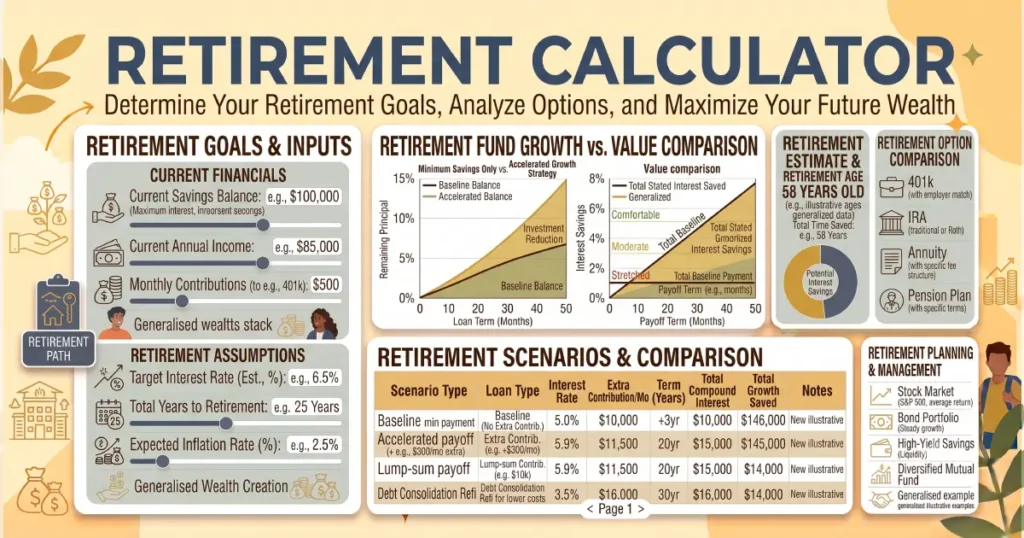
How a Retirement Calculator Works
A retirement calculator estimates your future retirement balance by projecting how your savings may grow over time and comparing that amount with your expected retirement expenses.
Most calculations consider:
- Current retirement savings
- Annual income
- Monthly or annual contributions
- Expected investment return
- Current age
- Retirement age
- Expected retirement length
- Inflation rate
The result is an estimate of whether your projected savings may be enough to support your desired lifestyle after leaving the workforce.
What Information Do You Need?
| Input | Why It Matters |
|---|---|
| Current age | Determines how many years you have to save and invest. |
| Retirement age | Shows how long your savings have to grow. |
| Current savings | Provides the starting point for projections. |
| Annual income | Helps estimate future contributions. |
| Monthly contribution | Shows how additional savings affect your retirement balance. |
| Expected return | Estimates potential investment growth. |
| Retirement expenses | Helps determine how much income you may need later. |
Why Use a Retirement Calculator?
Retirement planning involves many assumptions, and small changes can have a major effect over several decades. A calculator helps you understand how saving decisions today may influence your future financial security.
Common reasons people use retirement calculators include:
- Estimating how much they need to save before retirement.
- Determining whether current contributions are sufficient.
- Understanding the effect of retiring earlier or later.
- Planning around expected retirement expenses.
- Comparing different savings strategies.
How Much Money Do You Need for Retirement?
The amount needed for retirement depends on your lifestyle, expected expenses, income sources, and how long your retirement lasts. There is no single retirement number that works for everyone.
Important factors include:
- Housing costs and mortgage payments
- Healthcare expenses
- Travel and hobbies
- Taxes during retirement
- Inflation
- Expected Social Security or pension income
A retirement calculator helps estimate these factors instead of relying on a general savings target.
The Importance of Compound Growth
Time is one of the most important factors in retirement savings. Money invested over many years can potentially grow through compound returns, where earnings generate additional earnings.
Starting early can make a significant difference because your savings have more time to grow. However, people who start later can still improve their retirement outlook by increasing contributions, adjusting expenses, or delaying retirement.
Factors That Affect Retirement Savings
Savings Rate
The percentage of your income that you save can strongly influence your retirement readiness. Increasing contributions may help build a larger retirement balance over time.
Investment Returns
Your investment performance affects how quickly your retirement savings grow. Higher potential returns usually involve greater investment risk.
Inflation
Inflation reduces purchasing power over time. A retirement plan should consider that future expenses may cost more than they do today.
Retirement Age
Retiring earlier may require more savings because your investments need to support a longer period without employment income.
Healthcare Costs
Healthcare expenses can become a significant part of retirement spending, especially as people get older.
Retirement Account Types to Consider
| Account Type | Description |
|---|---|
| 401(k) | Employer-sponsored retirement plan that often includes contribution options and possible employer matching. |
| Traditional IRA | Individual retirement account with potential tax advantages depending on eligibility. |
| Roth IRA | Retirement account funded with after-tax contributions that may provide tax-free qualified withdrawals. |
| Pension | Employer-provided retirement income based on specific plan rules. |
Common Retirement Planning Mistakes
- Waiting too long to start saving.
- Underestimating healthcare expenses.
- Ignoring inflation.
- Assuming investment returns are guaranteed.
- Not increasing savings as income grows.
- Focusing only on account balances instead of retirement expenses.
How to Improve Your Retirement Outlook
- Increase retirement contributions when possible.
- Take advantage of employer retirement benefits.
- Create a realistic estimate of future expenses.
- Review your investment strategy regularly.
- Reduce unnecessary debt before retirement.
- Adjust your retirement timeline if needed.
A retirement calculator can help you test different scenarios, such as saving more each month, retiring later, or changing expected investment returns.
Frequently Asked Questions
A retirement calculator estimates how much money you may need to save and whether your current savings plan could support your future retirement goals. It uses information such as income, savings, contributions, investment returns, and retirement expenses.
The amount needed varies based on your lifestyle, expenses, retirement age, healthcare costs, and income sources. A retirement calculator provides a personalized estimate rather than using a single savings target.
A retirement calculator provides an estimate based on assumptions about future returns, inflation, and expenses. Actual results may differ because investment performance, costs, and personal circumstances can change over time.
Starting as early as possible allows more time for compound growth. However, increasing contributions, adjusting expenses, and improving savings habits can help at any stage of life.
The ideal contribution depends on your income, expenses, retirement goals, and current savings. A calculator can help you compare different contribution amounts and their potential long-term effects.
Some retirement calculators allow you to include expected Social Security benefits or other income sources. Including these estimates can provide a more complete view of your future retirement income.
Yes. A retirement calculator can help estimate whether early retirement is possible by showing how changes in savings, expenses, investment returns, and retirement age affect your financial plan.
Many retirement calculators include inflation assumptions because the cost of goods and services typically increases over time. Accounting for inflation helps create a more realistic estimate of future expenses.