An education savings calculator helps families estimate how much they may need to save for future education expenses and whether their current savings plan is likely to meet that goal. By entering the child's current age, expected education costs, annual savings, investment growth, and inflation assumptions, you can project the value of your education fund and identify any potential funding gap.
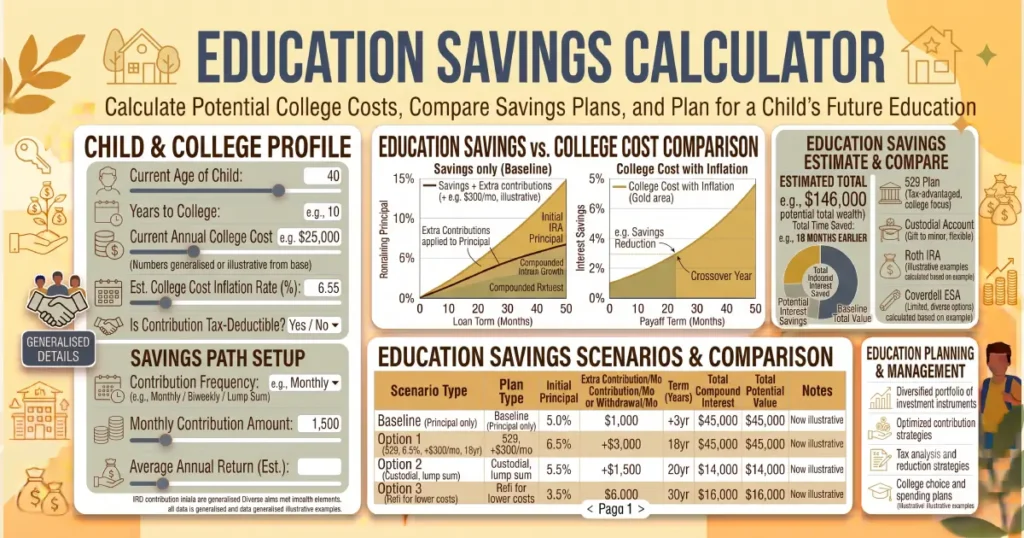
How an Education Savings Calculator Works
An education savings calculator estimates the future cost of college or other education expenses by combining projected tuition inflation with the growth of your savings over time.
Most calculators estimate:
- College savings goal
- Projected future education costs
- Estimated investment growth
- Total contributions over time
- Expected account balance at enrollment
- Potential funding shortfall or surplus
Because future education costs and investment returns are uncertain, the results should be viewed as estimates rather than guarantees.
What Information Do You Need?
| Input | Description |
|---|---|
| Child's current age | The number of years until college or another education program begins. |
| Current savings | The amount already saved for education. |
| Monthly contribution | The amount you plan to save each month. |
| Expected annual return | The estimated investment growth rate. |
| Education inflation rate | The estimated yearly increase in education costs. |
| Target education cost | Your estimate of future tuition and related expenses. |
Why Use an Education Savings Calculator?
Education costs can rise significantly over time. A calculator helps you estimate whether your current savings strategy is likely to keep pace with those increasing expenses.
- Estimate future college costs.
- Create a realistic savings target.
- Determine how much to save each month.
- Measure the impact of investment growth.
- Compare different savings scenarios.
- Adjust your plan as financial goals change.
What Education Expenses Should You Include?
Many families focus only on tuition, but education often involves several additional costs.
| Expense | Examples |
|---|---|
| Tuition and fees | Required enrollment charges. |
| Housing | On-campus housing or off-campus rent. |
| Meals | Meal plans and food expenses. |
| Books and supplies | Textbooks, software, and classroom materials. |
| Transportation | Travel to and from school. |
| Personal expenses | Everyday living costs and miscellaneous expenses. |
Including these costs provides a more complete estimate of the amount you may need to save.
How Investment Growth Affects College Savings
The earlier you begin saving, the more time your investments may have to grow through compounding. Even modest monthly contributions can accumulate over many years.
A college savings calculator illustrates how increasing your monthly contributions or earning higher long-term investment returns may improve your projected balance.
| Factor | Potential Effect |
|---|---|
| Earlier start | More time for compound growth. |
| Higher monthly contributions | Larger future savings balance. |
| Higher investment returns | Greater long-term account growth. |
| Higher education inflation | Larger savings goal. |
Popular Education Savings Options
Families use different strategies to save for education depending on their financial goals and tax situation.
- 529 plan calculator projections for qualified education savings plans.
- Coverdell Education Savings Accounts (ESAs).
- Taxable investment accounts.
- High-yield savings accounts.
- Certificates of deposit (CDs).
- Custodial investment accounts.
Each option offers different features related to investment flexibility, taxes, contribution limits, and eligible education expenses.
Factors That Affect Your Savings Goal
Current Age
The younger the beneficiary, the more years you have to contribute and benefit from investment growth.
Education Inflation
College costs have historically increased over time, making inflation an important factor when planning long-term savings.
Monthly Contributions
Consistent contributions can significantly increase your projected education fund.
Investment Performance
Your expected rate of return affects how quickly your savings may grow, although future returns are never guaranteed.
School Choice
Estimated costs vary depending on the type of institution, location, program length, and housing arrangements.
Tips for Saving for Education
- Start saving as early as possible.
- Contribute regularly instead of waiting for large deposits.
- Increase contributions when your income grows.
- Review your savings progress each year.
- Reassess investment allocations as enrollment approaches.
- Adjust your goal if education costs or family circumstances change.
Common Education Savings Mistakes
- Waiting too long to begin saving.
- Ignoring future education inflation.
- Saving only for tuition while overlooking other expenses.
- Contributing inconsistently.
- Never reviewing the savings plan.
- Assuming investment returns are guaranteed.
Education Savings Calculator Example
Suppose your child is five years old, you have already saved $8,000, and you contribute $250 each month. By estimating investment growth and future education inflation, the calculator projects how much may be available when college begins.
| Input | Example |
|---|---|
| Current savings | $8,000 |
| Monthly contribution | $250 |
| Years until college | 13 |
| Estimated annual return | 6% |
Changing any of these assumptions allows you to compare different savings strategies and estimate how much additional saving may be needed.
Frequently Asked Questions
An education savings calculator estimates how much you may accumulate for future education expenses based on your current savings, ongoing contributions, expected investment returns, and projected education costs.
The amount depends on the expected cost of the school, the child's age, your investment assumptions, and how much of the expenses you plan to cover. A calculator helps estimate an appropriate savings goal.
A college savings calculator combines your contributions, expected investment growth, and estimated education inflation to project the future value of your education savings.
In addition to tuition, many families include housing, meals, books, transportation, supplies, and personal expenses when estimating future education costs.
Investment growth may increase the value of your savings over time, but returns are not guaranteed. Starting early allows more time for compounding to work.
A 529 plan is a tax-advantaged education savings account designed to help families save for qualified education expenses. Features and tax treatment vary by state and individual circumstances.
Reviewing your plan annually allows you to adjust contributions, update investment assumptions, and account for changes in education costs or financial goals.
Yes. Many calculators can estimate savings goals for private K–12 education, college, graduate school, or other educational programs by adjusting the expected costs and timeline.
If your projected savings fall short, you may increase future contributions, extend your savings timeline if possible, consider lower-cost education options, or explore scholarships, grants, and other funding sources.