A Required Minimum Distribution Calculator helps estimate the minimum amount you must withdraw each year from certain tax-deferred retirement accounts once you reach the applicable RMD age. By entering your age, eligible retirement account balance, and beneficiary information when required, you can estimate your annual required minimum distribution and better prepare for potential tax obligations.
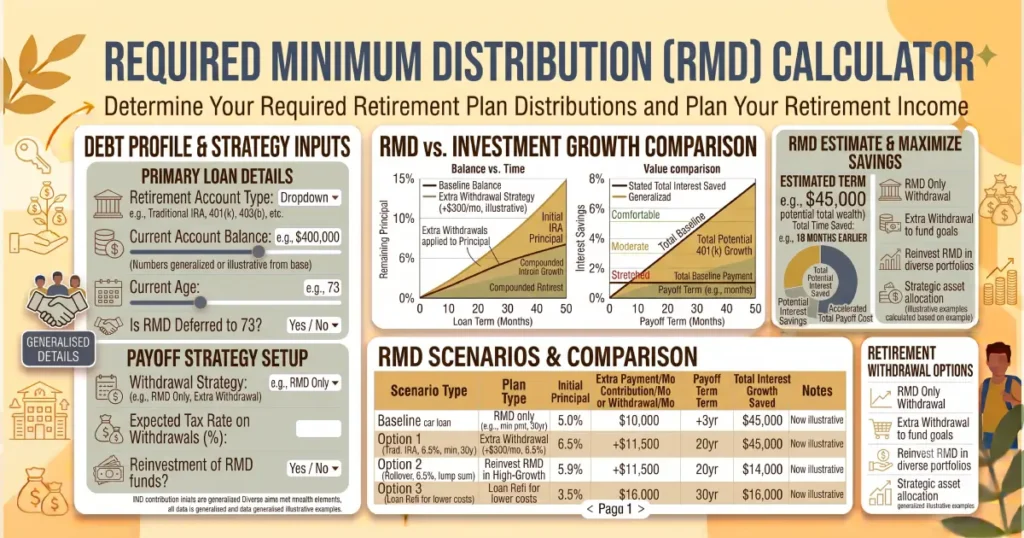
Understanding your RMD is an important part of retirement planning. Taking too little may result in IRS penalties, while withdrawing more than necessary could increase your taxable income for the year. An RMD calculator simplifies the calculation and helps you plan withdrawals with greater confidence. The SECURE 2.0 Act increased the beginning age for many retirees and also eliminated lifetime RMDs for Roth 401(k) accounts beginning in 2024.
How a Required Minimum Distribution Calculator Works
A RMD calculator estimates your required annual withdrawal using IRS life expectancy tables. In most situations, the calculation begins with your retirement account balance as of December 31 of the previous year and divides that amount by the applicable life expectancy factor published by the IRS.
Most calculators estimate:
- Required Minimum Distribution (RMD)
- Estimated taxable withdrawal
- Remaining retirement account balance after distribution
- Estimated distribution percentage
- Future RMD projections
What Information Do You Need?
| Input | Description |
|---|---|
| Age | Your age for the distribution year. |
| Previous year-end balance | Your retirement account balance as of December 31 of the prior year. |
| Retirement account type | Traditional IRA, 401(k), SEP IRA, SIMPLE IRA, or another eligible account. |
| Beneficiary information | Needed in certain situations, such as when your spouse is your sole beneficiary and is more than 10 years younger. |
Who Must Take Required Minimum Distributions?
Required minimum distributions generally apply to owners of tax-deferred retirement accounts. Under current law, most individuals must begin taking RMDs when they reach the applicable age established under the SECURE 2.0 Act.
- Traditional IRA owners.
- SEP IRA participants.
- SIMPLE IRA participants.
- 401(k) plan participants.
- 403(b) plan participants.
- 457(b) governmental plan participants.
- Certain inherited retirement account beneficiaries.
Roth IRA owners are not required to take lifetime RMDs. Beginning in 2024, designated Roth accounts in employer-sponsored plans, such as Roth 401(k)s, are also exempt from lifetime RMD requirements.
When Do RMDs Begin?
Your required beginning age depends on your birth year.
| Birth Year | Applicable RMD Age |
|---|---|
| 1950 or earlier | 72 (under prior law) |
| 1951–1959 | 73 |
| 1960 or later | 75 (beginning in 2033) |
Your first RMD may generally be delayed until April 1 of the year following the year you reach your required beginning age. However, delaying the first withdrawal usually means taking two RMDs during the same calendar year, which could increase taxable income.
Retirement Accounts Subject to RMD Rules
| Account Type | Lifetime RMD Required? |
|---|---|
| Traditional IRA | Yes |
| SEP IRA | Yes |
| SIMPLE IRA | Yes |
| 401(k) | Yes, subject to applicable rules. |
| 403(b) | Yes |
| Governmental 457(b) | Yes |
| Roth IRA | No |
| Roth 401(k) | No (beginning in 2024) |
How Is an RMD Calculated?
In most cases, the calculation follows a simple process:
- Determine your eligible retirement account balance on December 31 of the previous year.
- Locate the appropriate IRS life expectancy factor.
- Divide the account balance by the applicable distribution period.
For example, if your retirement account balance is $500,000 and your IRS distribution factor is 26.5, your estimated required minimum distribution would be approximately $18,868 for the year.
Most account owners use the IRS Uniform Lifetime Table. A different life expectancy table generally applies if your spouse is your sole beneficiary and is more than 10 years younger than you.
Factors That Affect Your RMD
- Your age.
- Your retirement account balance.
- The applicable IRS life expectancy table.
- Your beneficiary designation.
- The type of retirement account you own.
- Whether you are still working and participating in an employer-sponsored retirement plan under an applicable exception.
Even though investment performance changes your account balance from year to year, the calculation always begins with the previous December 31 balance rather than the current market value.
Why an RMD Calculator Is Useful
- Estimate annual retirement withdrawals.
- Avoid costly IRS penalties.
- Prepare for income taxes.
- Support retirement cash-flow planning.
- Coordinate withdrawals across multiple retirement accounts.
- Estimate future RMDs as your account balance changes.
SECURE 2.0 Act Changes to RMD Rules
Recent retirement legislation changed when many individuals must begin taking required minimum distributions. The SECURE 2.0 Act increased the beginning age for many retirees and also reduced the excise tax that generally applies when an RMD is missed.
| Rule | Current Treatment |
|---|---|
| Beginning age | 73 for individuals born between 1951 and 1959; 75 for many individuals born in 1960 or later. |
| Roth 401(k) lifetime RMDs | Eliminated beginning in 2024. |
| Missed RMD penalty | Generally reduced to 25%, and potentially 10% if corrected within the applicable correction window. |
Although these changes provide additional flexibility for many retirees, inherited retirement accounts may follow different distribution rules depending on the beneficiary's relationship to the original account owner and the year of inheritance.
What Happens If You Miss an RMD?
Failing to withdraw your full required minimum distribution can result in an IRS excise tax on the amount that should have been distributed but was not. Under current law, the standard penalty is generally 25% of the missed amount. If the error is corrected within the applicable correction period, the penalty may be reduced to 10%.
If you discover that you missed an RMD, correcting the mistake as soon as possible and following IRS procedures may reduce potential penalties.
Are Required Minimum Distributions Taxable?
For most tax-deferred retirement accounts, RMDs are generally included in ordinary taxable income for the year in which they are received. The distribution may affect your federal income tax liability and could also influence the taxation of Social Security benefits, Medicare premium surcharges, or certain tax credits depending on your overall income.
Because tax situations vary, estimating your RMD before the end of the year can help you plan withdrawals more efficiently and avoid unexpected tax consequences.
Can You Reduce the Tax Impact of RMDs?
While you generally cannot avoid required minimum distributions once they apply, there may be ways to manage their tax impact as part of a broader retirement income strategy.
- Spread withdrawals throughout the year instead of taking a single distribution.
- Coordinate withdrawals with other taxable income.
- Consider qualified charitable distributions if you are eligible.
- Review Roth conversion opportunities before RMDs begin, when appropriate.
- Work with a qualified tax professional when making significant retirement withdrawal decisions.
The best strategy depends on your retirement income, filing status, tax bracket, and long-term financial goals.
Common RMD Mistakes
- Using the current account balance instead of the previous December 31 balance.
- Applying the wrong IRS life expectancy table.
- Forgetting about an old employer retirement account.
- Waiting until the last minute to calculate the distribution.
- Assuming Roth 401(k) accounts still require lifetime RMDs.
- Failing to understand inherited retirement account distribution rules.
- Withdrawing less than the required minimum amount.
Required Minimum Distribution Calculator Example
Suppose you are 74 years old and your Traditional IRA had a balance of $820,000 on December 31 of the previous year. Using the applicable IRS life expectancy factor, your estimated required minimum distribution can be calculated by dividing the account balance by the distribution period.
| Item | Example |
|---|---|
| Previous year-end balance | $820,000 |
| Applicable distribution factor | 25.5 |
| Estimated RMD | $32,157 |
This example is for illustration only. Your actual RMD may differ depending on your retirement account type, beneficiary designation, and the applicable IRS life expectancy table.
Tips for Managing Required Minimum Distributions
- Calculate your RMD early each year.
- Verify account balances using your year-end statements.
- Keep beneficiary designations current.
- Coordinate withdrawals with your overall retirement income plan.
- Review tax withholding options before taking distributions.
- Maintain records of all retirement distributions for tax reporting.
Frequently Asked Questions
A Required Minimum Distribution Calculator estimates the minimum amount you must withdraw each year from eligible tax-deferred retirement accounts based on your age, account balance, and applicable IRS life expectancy tables.
Your RMD is generally calculated by dividing your retirement account balance as of December 31 of the previous year by the applicable IRS life expectancy factor for your age and circumstances.
Under current law, many individuals begin RMDs at age 73. For many people born in 1960 or later, the required beginning age increases to 75 under the SECURE 2.0 Act.
No. Original owners of Roth IRAs are not required to take lifetime required minimum distributions. However, inherited Roth IRAs may follow separate distribution rules depending on the beneficiary.
Beginning in 2024, designated Roth accounts in employer-sponsored retirement plans, including Roth 401(k)s, are no longer subject to lifetime required minimum distributions for the original account owner.
Missing all or part of your required minimum distribution may result in an IRS excise tax. Correcting the mistake within the applicable correction period may reduce the penalty.
In most cases, distributions from Traditional IRAs and other tax-deferred retirement accounts are included in your taxable income for the year the distribution is received.
Yes. You may withdraw more than the required minimum amount. However, excess withdrawals generally do not reduce future RMD requirements and may increase your taxable income for the year.
Traditional IRAs, SEP IRAs, SIMPLE IRAs, 401(k)s, 403(b)s, governmental 457(b) plans, and certain inherited retirement accounts are generally subject to required minimum distribution rules.
Your retirement account balance and IRS life expectancy factor change over time. Using an RMD calculator annually helps estimate the correct withdrawal amount, supports retirement income planning, and reduces the risk of costly calculation errors.
What is a Required Minimum Distribution calculator?
A Required Minimum Distribution Calculator estimates the minimum amount you must withdraw each year from eligible tax-deferred retirement accounts based on your age, account balance, and applicable IRS life expectancy tables.
How is my RMD calculated?
Your RMD is generally calculated by dividing your retirement account balance as of December 31 of the previous year by the applicable IRS life expectancy factor for your age and circumstances.
At what age do required minimum distributions begin?
Under current law, many individuals begin RMDs at age 73. For many people born in 1960 or later, the required beginning age increases to 75 under the SECURE 2.0 Act.
Do Roth IRAs require minimum distributions?
No. Original owners of Roth IRAs are not required to take lifetime required minimum distributions. However, inherited Roth IRAs may follow separate distribution rules depending on the beneficiary.
Do Roth 401(k) accounts have RMDs?
Beginning in 2024, designated Roth accounts in employer-sponsored retirement plans, including Roth 401(k)s, are no longer subject to lifetime required minimum distributions for the original account owner.
What happens if I don't take my full RMD?
Missing all or part of your required minimum distribution may result in an IRS excise tax. Correcting the mistake within the applicable correction period may reduce the penalty.
Are required minimum distributions taxable?
In most cases, distributions from Traditional IRAs and other tax-deferred retirement accounts are included in your taxable income for the year the distribution is received.
Can I withdraw more than my required minimum distribution?
Yes. You may withdraw more than the required minimum amount. However, excess withdrawals generally do not reduce future RMD requirements and may increase your taxable income for the year.
Which retirement accounts require RMDs?
Traditional IRAs, SEP IRAs, SIMPLE IRAs, 401(k)s, 403(b)s, governmental 457(b) plans, and certain inherited retirement accounts are generally subject to required minimum distribution rules.
Why should I use an RMD calculator every year?
Your retirement account balance and IRS life expectancy factor change over time. Using an RMD calculator annually helps estimate the correct withdrawal amount, supports retirement income planning, and reduces the risk of costly calculation errors.