A Roth IRA Contribution Calculator helps determine how much you can contribute to a Roth Individual Retirement Account (IRA) for a specific tax year based on your age, filing status, earned income, and Modified Adjusted Gross Income (MAGI). Unlike a Roth IRA growth calculator, which estimates future investment value, this calculator focuses on your annual contribution eligibility under current IRS rules.
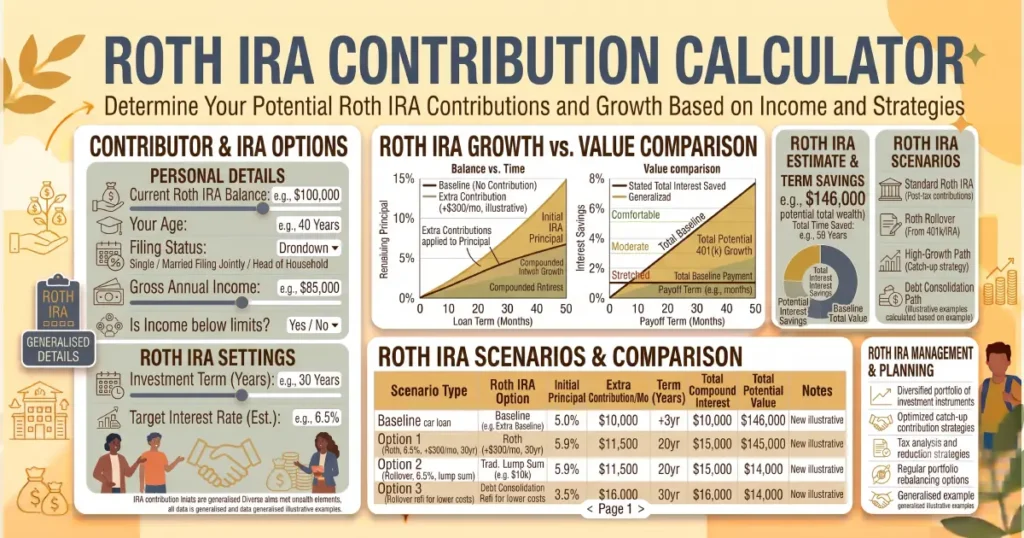
Contribution limits are adjusted periodically for inflation, and income limits determine whether you qualify for a full contribution, a reduced contribution, or no direct Roth IRA contribution at all. Using a calculator before making contributions can help you avoid excess contributions and potential IRS penalties. For 2026, the annual IRA contribution limit increased to $7,500, with updated income phase-out ranges for Roth IRA eligibility.
How a Roth IRA Contribution Calculator Works
A Roth IRA contribution calculator estimates your maximum allowable contribution using IRS contribution limits and income phase-out rules. After entering a few financial details, the calculator determines whether you qualify for the full contribution, a reduced contribution, or are ineligible to contribute directly.
Most calculators estimate:
- Maximum annual Roth IRA contribution
- Income eligibility
- Reduced contribution amount during the phase-out range
- Catch-up contribution eligibility for individuals age 50 or older
- Potential excess contribution amount
Information You'll Need
| Input | Description |
|---|---|
| Tax year | The contribution year you want to calculate. |
| Age | Determines whether catch-up contributions apply. |
| Filing status | Single, Married Filing Jointly, Head of Household, Married Filing Separately, or Qualifying Surviving Spouse. |
| Modified Adjusted Gross Income (MAGI) | Used to determine Roth IRA eligibility. |
| Earned income | Your compensation must generally support the amount contributed. |
What Is Modified Adjusted Gross Income (MAGI)?
Your Modified Adjusted Gross Income (MAGI) is one of the most important factors in determining Roth IRA contribution eligibility. MAGI begins with your adjusted gross income and includes certain additions required under IRS rules.
Because Roth IRA eligibility depends on MAGI rather than gross salary alone, two individuals earning similar incomes may have different contribution limits after accounting for deductions and adjustments.
2026 Roth IRA Contribution Limits
For the 2026 tax year, the IRS increased the annual IRA contribution limit.
| Age | Maximum Contribution |
|---|---|
| Under 50 | $7,500 |
| 50 or older | $8,600 (includes catch-up contribution) |
Your contribution cannot exceed your eligible earned income for the year, even if the annual limit is higher.
2026 Roth IRA Income Limits
Your eligibility depends on both your filing status and your MAGI.
| Filing Status | Full Contribution | Phase-Out Range |
|---|---|---|
| Single or Head of Household | Below $153,000 | $153,000–$168,000 |
| Married Filing Jointly | Below $242,000 | $242,000–$252,000 |
| Married Filing Separately | Special IRS rules apply | $0–$10,000 |
If your income falls within the phase-out range, you may still qualify for a reduced Roth IRA contribution instead of the full annual limit.
How the Phase-Out Range Works
The IRS gradually reduces your allowable Roth IRA contribution once your MAGI enters the applicable phase-out range.
For example, a single taxpayer earning $160,000 in modified adjusted gross income generally cannot make the full annual contribution but may still qualify for a partial contribution. A Roth IRA Contribution Calculator performs this calculation automatically using the IRS formula.
Once your MAGI exceeds the upper limit of the phase-out range, direct Roth IRA contributions are generally no longer permitted for that tax year.
Who Can Contribute to a Roth IRA?
- Individuals with eligible earned income.
- Taxpayers whose MAGI falls within IRS eligibility limits.
- Workers of any age who meet contribution requirements.
- Married couples using spousal IRA rules when applicable.
Unlike traditional retirement rules from past decades, there is no maximum age for making Roth IRA contributions as long as you have eligible earned income and satisfy the applicable income limits.
Why Use a Roth IRA Contribution Calculator?
- Estimate your maximum allowable contribution.
- Avoid excess contributions.
- Understand income phase-out rules.
- Determine catch-up contribution eligibility.
- Plan retirement savings before year-end.
- Compare contribution scenarios as your income changes.
What Happens If You Contribute Too Much?
An excess Roth IRA contribution occurs when you contribute more than the IRS allows for the tax year. This may happen because your income exceeds the eligibility limits, your earned income is lower than your contribution, or you accidentally exceed the annual contribution limit across multiple IRAs.
If the excess contribution is not corrected by the applicable IRS deadline, it may be subject to a 6% excise tax for each year the excess amount remains in the account. Removing or correcting the excess contribution before the deadline can often help avoid ongoing penalties.
Roth IRA Contribution Calculator Example
Suppose you are 38 years old, file as Single, and have a Modified Adjusted Gross Income of $145,000 for the 2026 tax year.
| Item | Example |
|---|---|
| Age | 38 |
| Filing Status | Single |
| MAGI | $145,000 |
| Maximum Contribution | $7,500 |
| Estimated Eligibility | Full contribution permitted |
Now consider another taxpayer with the same filing status but a MAGI of $160,000. Because this income falls within the IRS phase-out range, the calculator would estimate a reduced contribution instead of the full annual limit.
Roth IRA Contribution Calculator vs. Roth IRA Calculator
| Calculator | Primary Purpose |
|---|---|
| Roth IRA Contribution Calculator | Determines how much you are allowed to contribute based on IRS income limits. |
| Roth IRA Calculator | Estimates how your Roth IRA investments may grow over time based on contributions and investment returns. |
Many investors use both tools together. First, they determine their maximum eligible contribution for the year. Then they estimate how those contributions may grow over decades through long-term investing.
Tips for Maximizing Roth IRA Contributions
- Contribute early in the year to allow more time for potential investment growth.
- Monitor your income if you expect to be near the IRS phase-out range.
- Set up automatic monthly contributions instead of waiting until the filing deadline.
- Review your eligibility annually because IRS limits and income thresholds may change.
- Consider increasing contributions after receiving raises or bonuses.
- Coordinate Roth IRA contributions with your overall retirement savings strategy.
Common Roth IRA Contribution Mistakes
- Using gross income instead of Modified Adjusted Gross Income (MAGI).
- Contributing more than your earned income.
- Ignoring annual IRS contribution limit changes.
- Making a full contribution despite being in the phase-out range.
- Forgetting catch-up contribution rules after age 50.
- Failing to correct excess contributions before the tax filing deadline.
- Confusing Roth IRA contribution eligibility with future investment growth projections.
Why Contribution Limits Matter
IRS contribution limits help determine who can contribute directly to a Roth IRA and how much can be invested each year. Staying within these limits helps preserve the tax advantages of the account while avoiding unnecessary penalties.
Because contribution eligibility depends on both income and tax filing status, checking your limits before making deposits is a simple way to prevent mistakes. A Roth IRA Contribution Calculator makes this process much easier by applying the current IRS rules automatically.
Frequently Asked Questions
A Roth IRA Contribution Calculator estimates the maximum amount you can contribute to a Roth IRA for a specific tax year based on your age, filing status, earned income, and Modified Adjusted Gross Income (MAGI).
For 2026, the annual IRA contribution limit is $7,500 for individuals under age 50. Those age 50 or older may contribute up to $8,600, including the applicable catch-up contribution, provided they meet IRS eligibility requirements.
Modified Adjusted Gross Income (MAGI) is the income measurement the IRS uses to determine Roth IRA contribution eligibility. If your MAGI falls within the applicable phase-out range, your maximum allowable contribution may be reduced.
Yes. You may contribute to both accounts during the same tax year, but your combined contributions generally cannot exceed the annual IRS contribution limit unless special rules apply.
If your MAGI exceeds the IRS income limits for direct Roth IRA contributions, you generally cannot make a direct contribution for that tax year. Some investors explore alternative retirement planning strategies depending on their circumstances.
An excess contribution may be subject to a 6% IRS excise tax each year it remains in the account. Correcting the excess before the applicable deadline can often reduce or eliminate additional penalties.
Yes. You generally cannot contribute more than your eligible earned income for the tax year, even if the annual contribution limit is higher.
A Roth IRA Contribution Calculator determines how much you may legally contribute under current IRS rules, while a Roth IRA Calculator estimates how your retirement investments may grow over time.
Yes. IRS contribution limits, income phase-out ranges, and your personal financial situation may change from year to year. Reviewing your eligibility annually helps ensure that your contributions remain within IRS limits.
Yes. Many investors contribute monthly, while others make a single contribution before the tax filing deadline. As long as your total contribution does not exceed your allowable limit for the tax year, either approach may be used.